
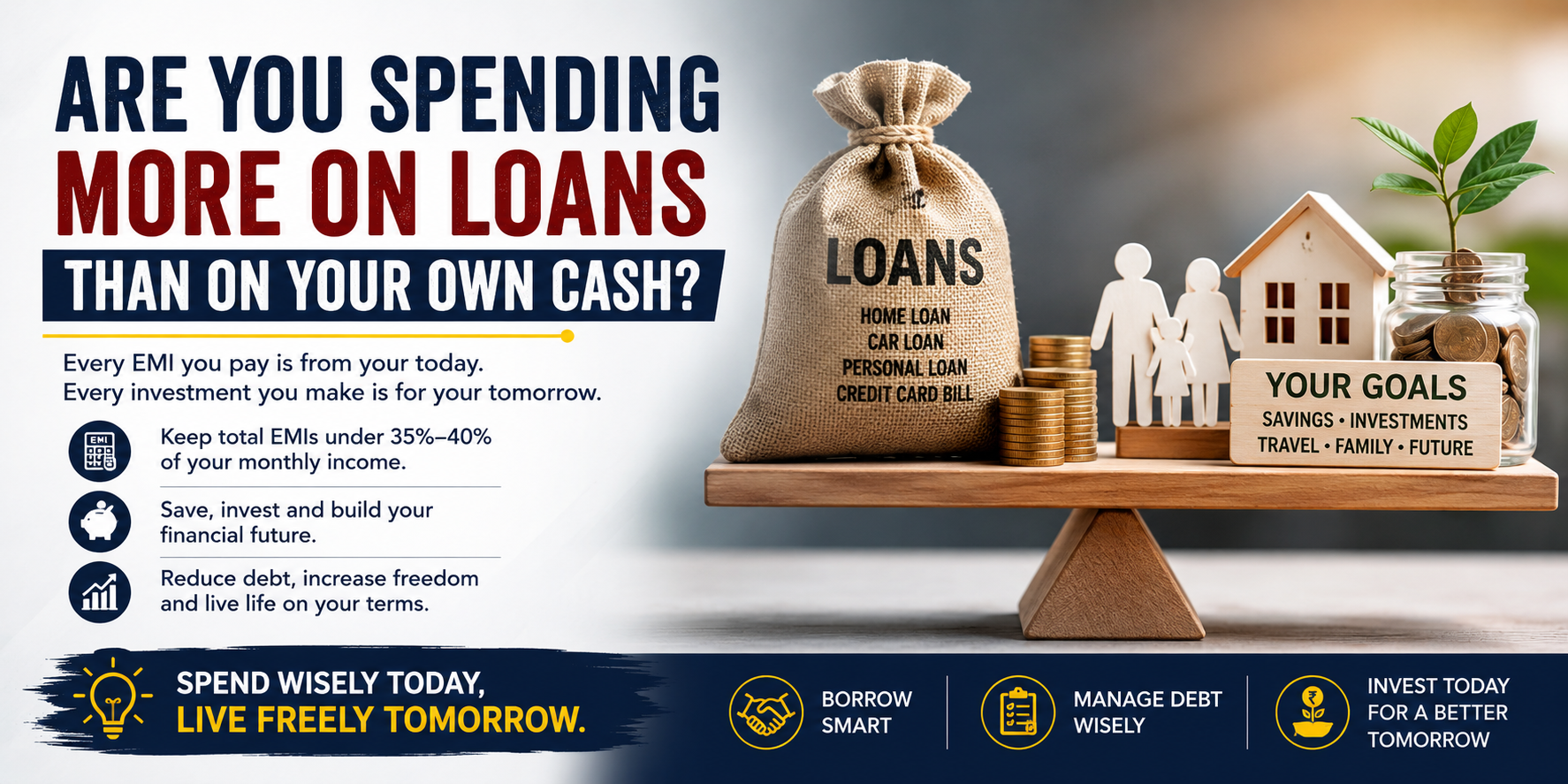
Every month, your salary gets credited. Within a few days, the money starts disappearing—home loan EMI, car loan EMI, personal loan EMI, credit card bill, and other commitments. Before you realize it, a large portion of your income has already been allocated to lenders.
This raises an important question:
Are you spending more on your loans than on your own financial future?
The Hidden Cost of Debt
Loans are not always bad. A home loan can help you build an asset, and an education loan can create future earning potential. However, problems begin when debt starts consuming a significant share of your monthly income.
If most of your salary goes towards EMIs, you may struggle to:
- Build an emergency fund.
- Save for retirement.
- Invest for long-term wealth.
- Travel or enjoy experiences.
- Handle unexpected financial emergencies.
In simple words, you start working for your loans instead of your goals.
A Simple Reality Check
Ask yourself these questions:
- Do my total EMIs exceed my monthly investments?
- Am I saving less than 20% of my income?
- Have I taken a new loan before repaying the previous one?
- Do I depend on my next salary just to clear this month's dues?
If your answer is "Yes" to two or more of these questions, it may be time to review your finances.
The Ideal EMI Rule
Financial planners often recommend keeping your total EMIs below 35%–40% of your monthly take-home income.
For example:
- Monthly take-home salary: ₹80,000
- Maximum recommended EMIs: ₹28,000–₹32,000
If your EMIs exceed this range, your financial flexibility starts shrinking.
Don't Confuse Lifestyle With Affordability
Many people qualify for large loans based on their income. But qualifying for a loan doesn't necessarily mean you can comfortably afford it.
Buying a more expensive car or upgrading to a bigger home may increase your monthly EMI, but it can also reduce your ability to save and invest.
Remember:
Banks calculate your repayment capacity. You should calculate your financial freedom.
Focus on Building Assets, Not Just Paying Liabilities
Imagine two people earning the same salary.
Person A
- Pays ₹45,000 in EMIs.
- Invests ₹5,000 every month.
Person B
- Pays ₹20,000 in EMIs.
- Invests ₹30,000 every month.
After several years, Person B is likely to have built a stronger financial foundation, despite spending less on expensive assets.
How to Reduce Your Debt Burden
- Avoid unnecessary personal loans.
- Pay off high-interest debt, especially credit cards, as early as possible.
- Increase your EMI when your income grows to reduce the loan tenure.
- Build an emergency fund to avoid borrowing during emergencies.
- Invest consistently, even while repaying loans.
Final Thoughts
Loans can help you achieve important milestones, but they should never control your financial life.
Every EMI is money committed to your past decisions. Every investment is money committed to your future.
Before taking your next loan, ask yourself:
"Am I spending more on my lenders than I am on building my own wealth?"
The answer to that question can shape your financial future.